Santorini Guide: Beyond Oia — Villages, Wine & Light

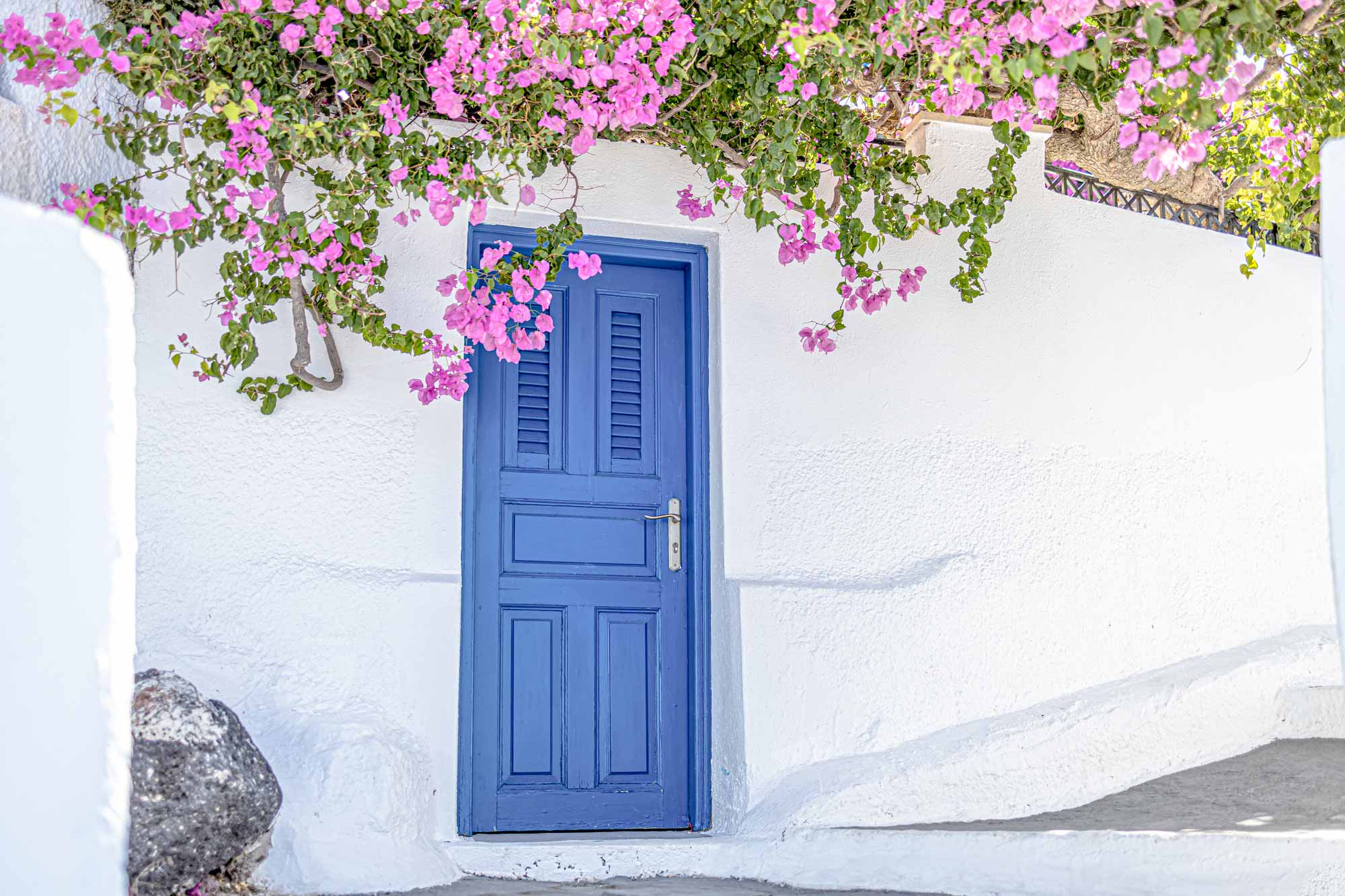
Greece on a postcard? That’s more than likely to be Santorini; its blue-and-white-domed architecture against a deep blue backdrop has tempted many a tourist to its shores. There are undeniable crowds that disgorge from cruise ships and congregate around Oia’s blue domes and the lanes of Fira. The trick to Santorini is to stay a while – a week, or, better, two, in a quiet house above Imerovigli or in the medieval lanes of Pyrgos, and an entirely different island reveals itself: a place of vanished civilisations and basket-trained vines, of slow morning swims off black volcanic sand, of cliffside dinners where the caldera turns from gold to bronze to indigo across the course of a single bottle of Assyrtiko. Allow us to show you Santorini, away from the crowds.

We recommend building your sightseeing around early mornings and post-sunset, when the island opens generously, to its geology, its food, its winemakers, and to a light that has drawn travellers, painters and writers for time immemorial.
A CALDERA-SHAPED ISLAND

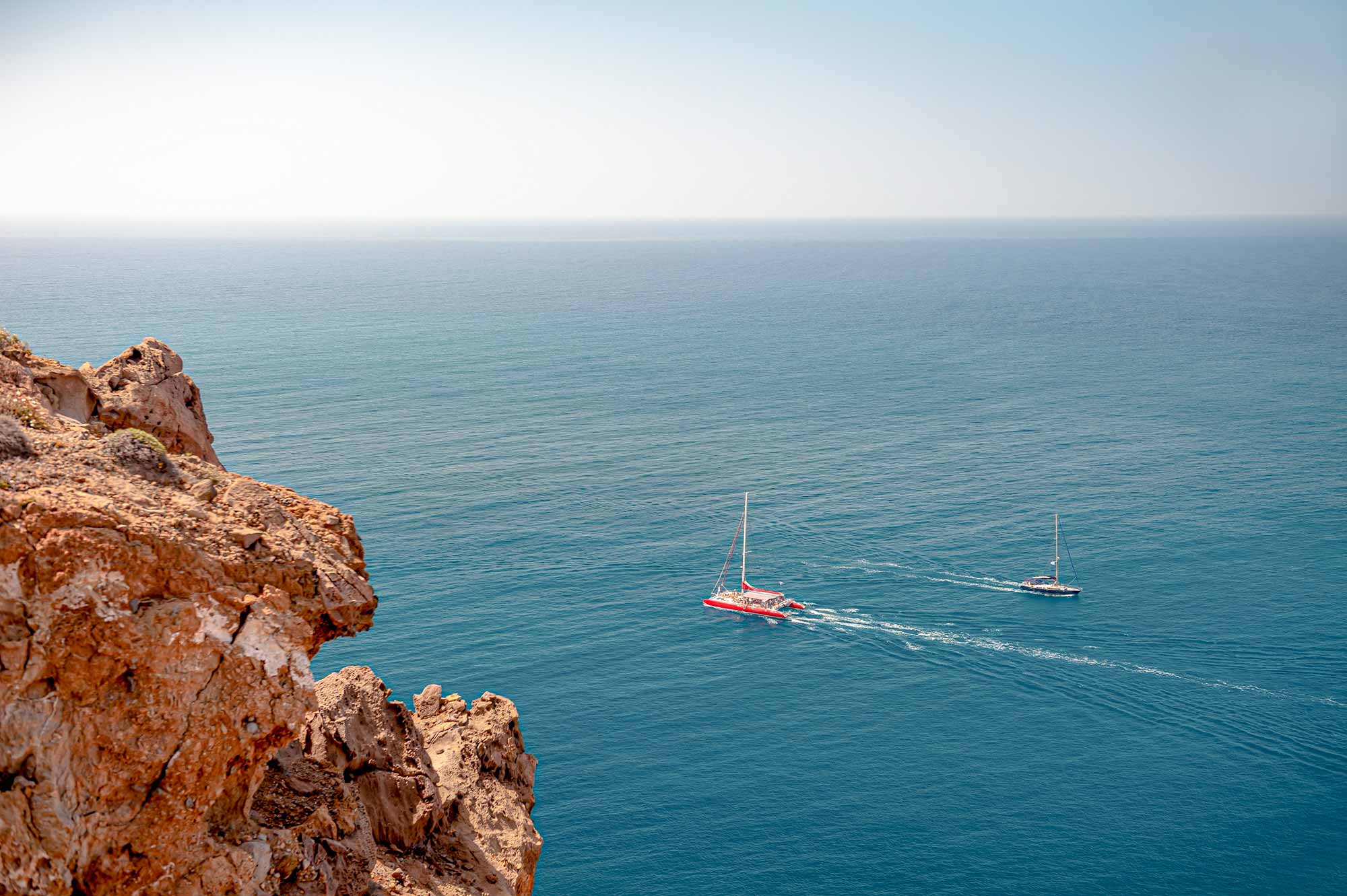
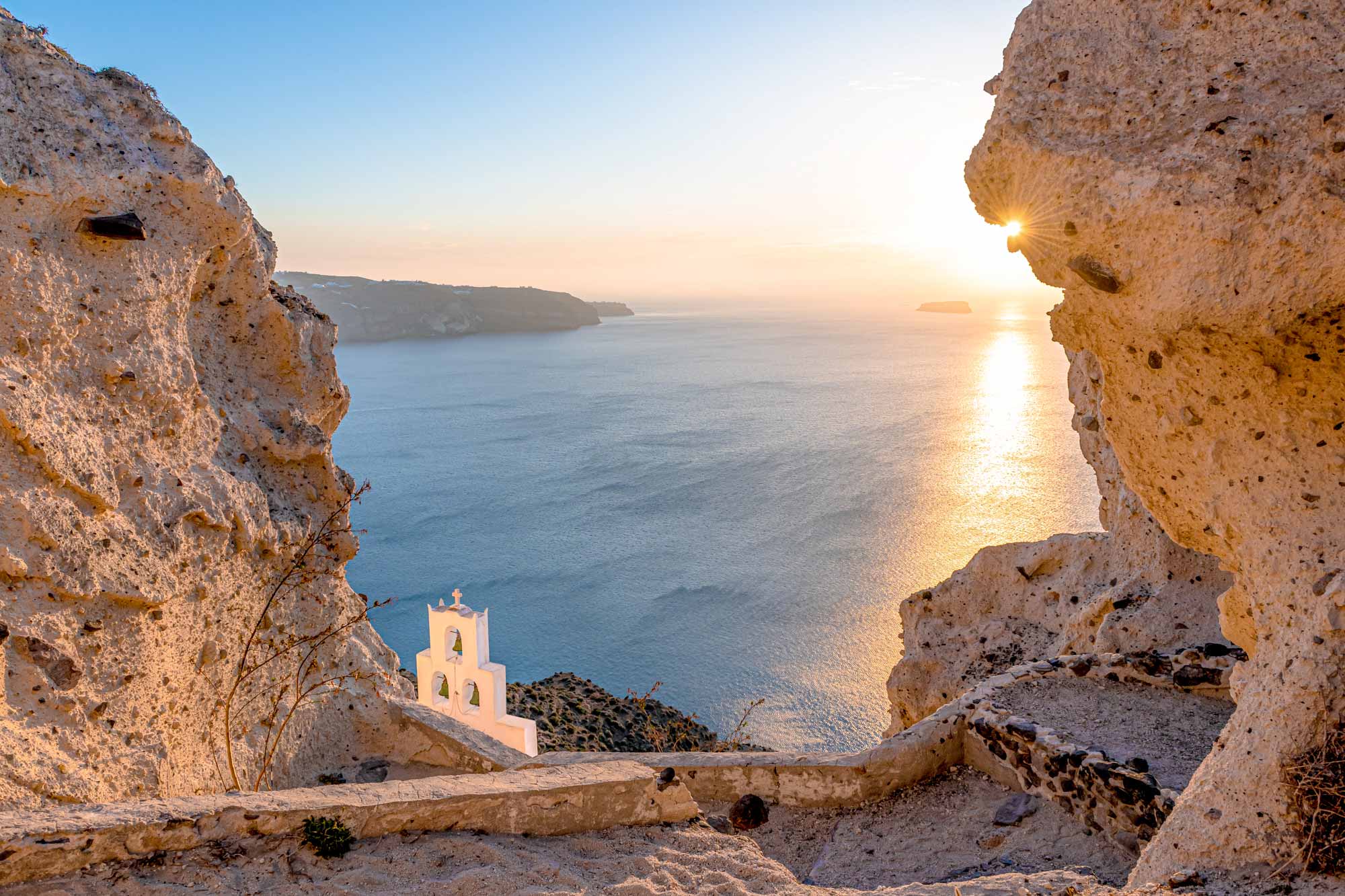
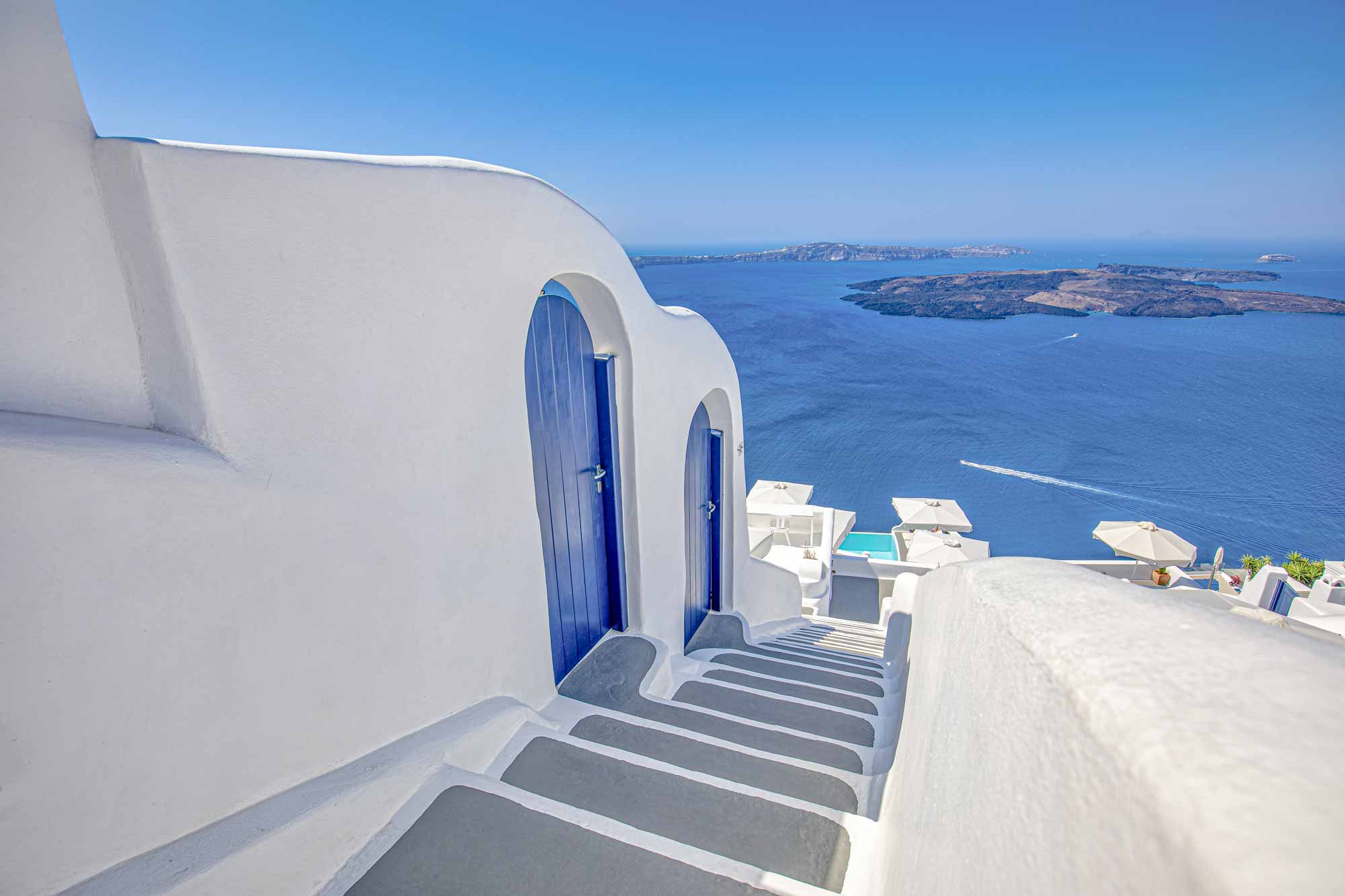
Santorini is not really an island so much as the rim of a flooded volcano. Around 3,600 years ago, in the middle of the Late Bronze Age, a vast eruption, among the most violent in human history, often compared in scale to Krakatoa, emptied the magma chamber beneath the island and collapsed its centre into the sea. What remained is the crescent you see today: a steep, sheer-sided arc of cliff falling some three hundred metres into the caldera, with the smaller islet of Thirassia opposite and the still-smoking volcanic islets of Nea and Palea Kameni in the middle, lazing in the bay like sleeping animals.

The geology shapes the island. The cliff face is striped in layers of pumice, ash and lava, a cross-section of the eruptions that built the island and the one that almost unmade it. The beaches on the outer, eastern coast are black, red and white, depending on which lava flow created them. The soil is mineral-rich and waterless. And the light, refracted off the white houses and the dark stone, has the particular Aegean clarity that photographers have spent a century trying to capture.

THE CLIFFSIDE VILLAGES: OIA, IMEROVIGLI, FIRA

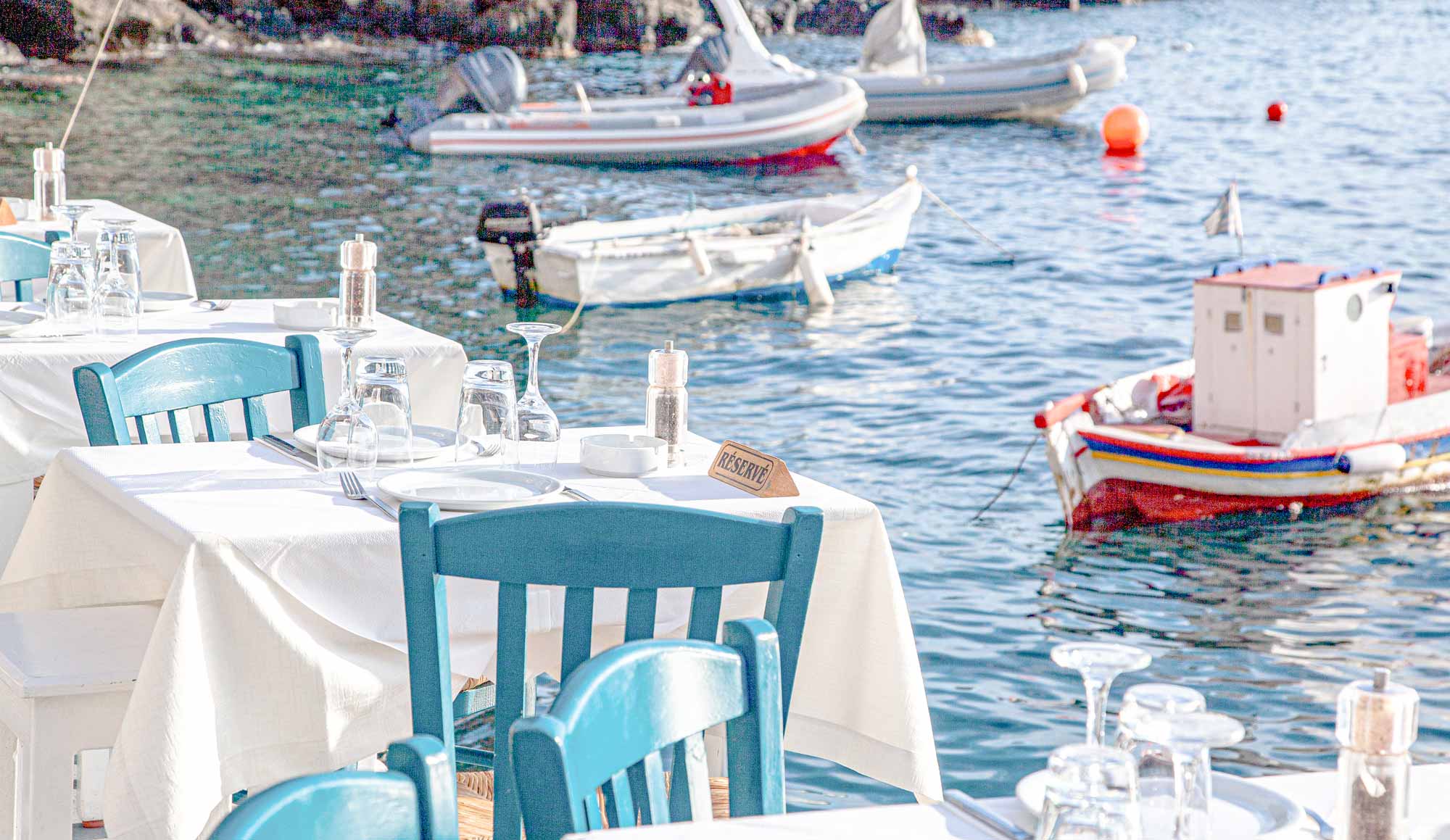
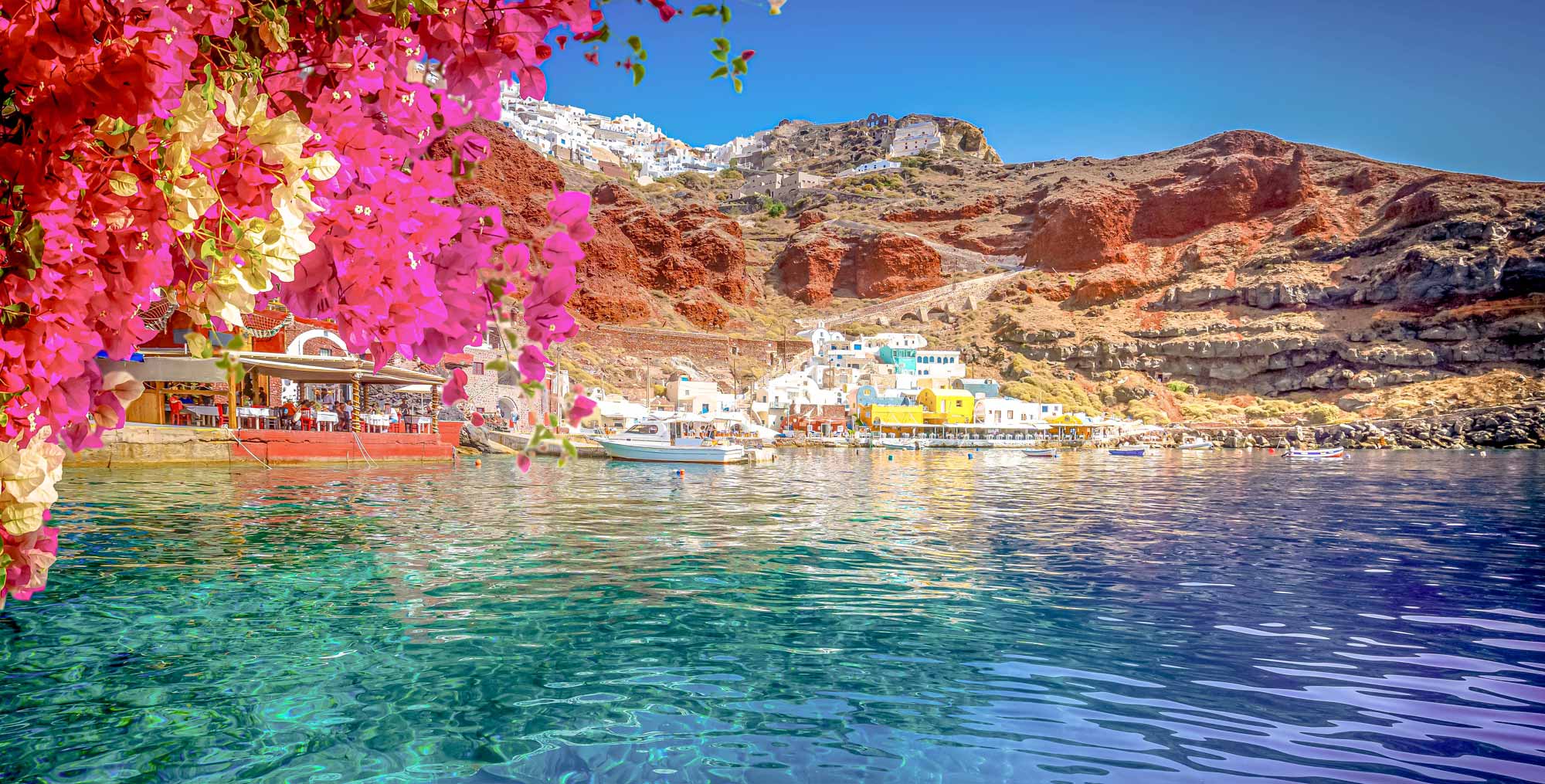
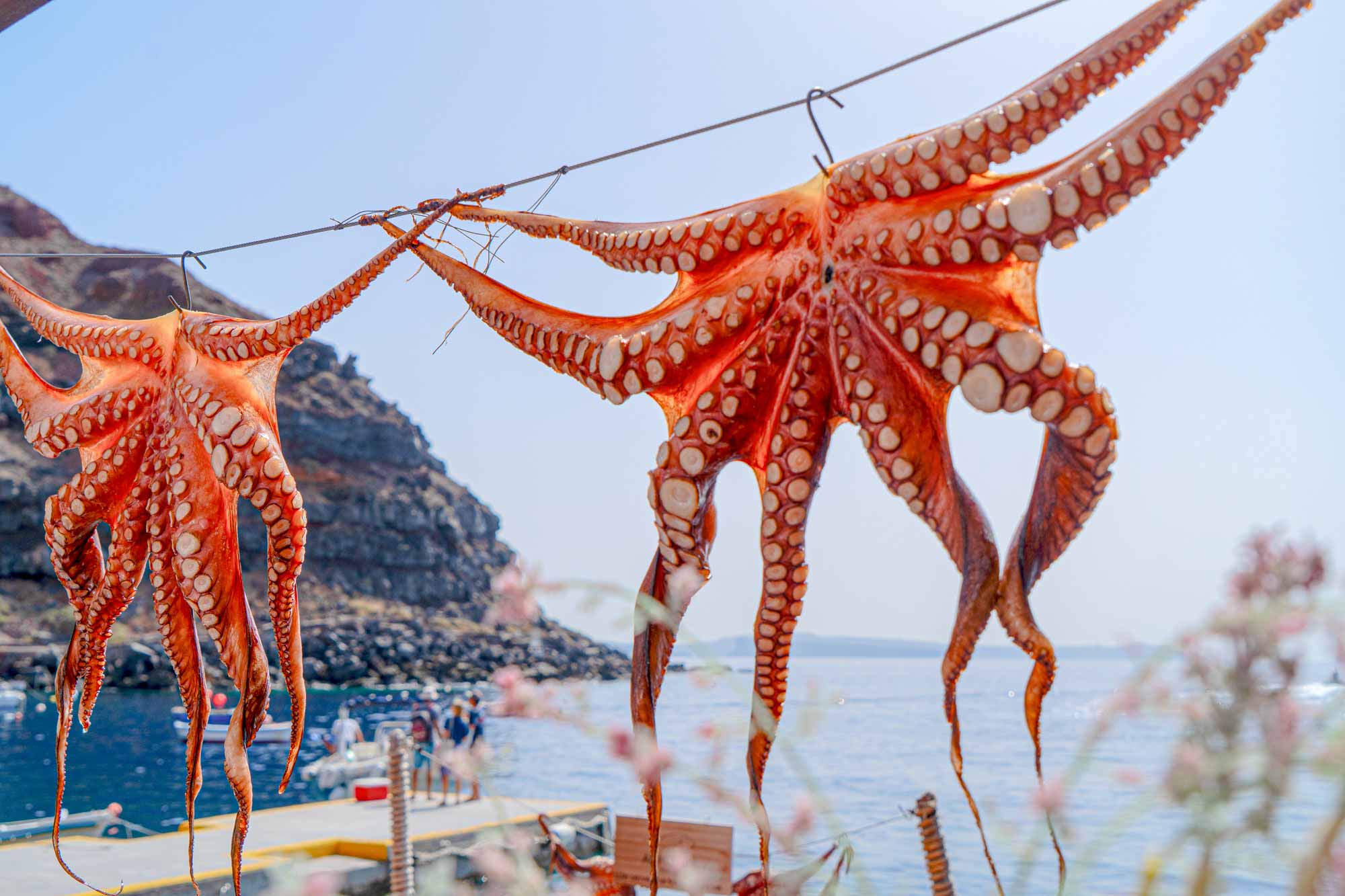
The three best-known villages on Santorini are strung along the caldera’s western rim. Oia, at the northern tip, is the most famous and the most photographed, a tumble of whitewashed houses, blue-domed churches and old captains’ mansions carved into the lava cliff. At sunset it is impossibly crowded; an hour after sunset, as the tour buses pull away, it is among the loveliest places in Greece. The small steep path from Oia down to Ammoudi Bay, three hundred or so steps, or a short drive, ends at a row of fish tavernas at the water’s edge, just perfect for a late lunch.

A few kilometres south, Imerovigli sits on the highest point of the caldera and is the quieter, more refined alternative to Oia: a village of low whitewashed houses and small, elegant hotels, with a footpath running south along the cliff edge to Skaros Rock, the dramatic basalt promontory that once held a Venetian fortress and now offers the most uninterrupted caldera view on the island. The walk takes twenty minutes and is best done in the last hour of light.

The capital, Fira, sits in the middle of the arc, busier, more commercial, and home to the island’s excellent Museum of Prehistoric Thera (where the finest of the Akrotiri frescoes are kept). It is the practical heart of any stay, the place for late-night cocktails, the cable car down to the old port, and a handful of the island’s best wine bars. Most travellers prefer to sleep elsewhere and visit Fira on foot or by car, a strategy we tend to recommend.

THE QUIETER INLAND VILLAGES

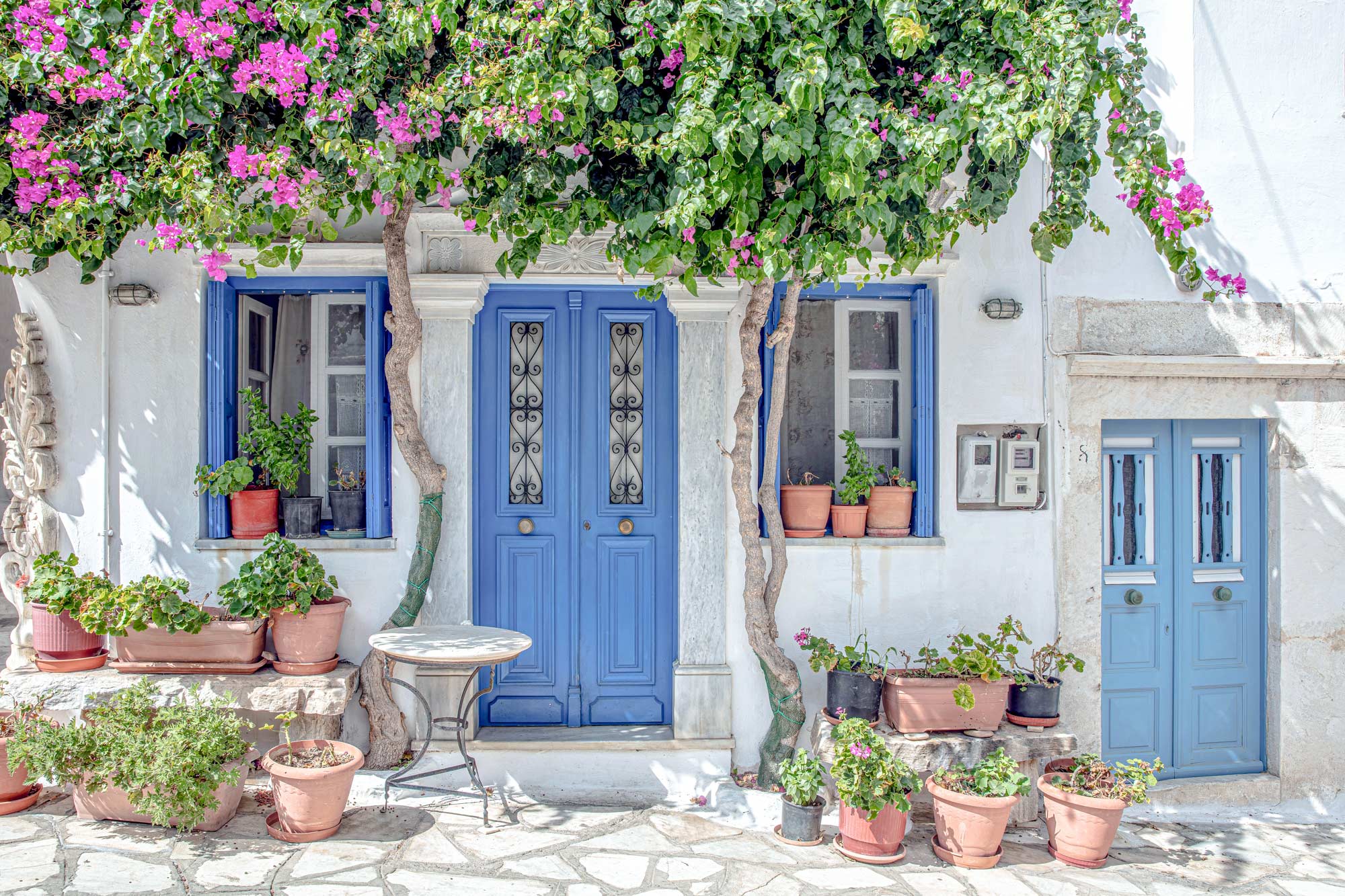
Away from the caldera rim, a different Santorini reveals itself, older, slower, and almost entirely overlooked by the day-trip crowd. Pyrgos is the most rewarding: a medieval village built around a Venetian castle at the island’s highest point, with panoramic views across to both coasts and a tangle of stone lanes that fill on Good Friday with one of the most atmospheric candlelit processions in the Cyclades. It was the island’s capital until the early 20th century, and still feels like one. The hilltop restaurant Selene, established in 1985, long regarded as the island’s most serious kitchen, sits just below the castle and is the place for a dinner drawn from Santorini’s homegrown ingredients.

A few minutes away, Megalochori is a small wine village of bell towers, vaulted cave houses and a shaded central square, with several of the island’s best wineries within a short drive. Further south, Emporio is Santorini’s largest inland village and home to one of the most remarkable medieval quarters in the Cyclades, the Kasteli, a fortified Venetian-era settlement still entirely inhabited, with laundry drying on parapets and cats asleep in 500-year-old doorways. And on the south-western tip, the village and archaeological site of Akrotiri is Greece’s answer to Pompeii, while at the very end of the road stands the 19th-century Akrotiri Lighthouse, built by a French trading company in 1892 and still one of the loveliest sunset perches on Santorini.

THE DRAMA OF VOLCANIC BEACHES

Santorini’s beaches are unlike any others in the Cyclades. The outer, eastern and southern coasts, the side of the island that slopes gently to the sea, rather than falling sheer into the caldera, are lined with long stretches of black, red and even white volcanic sand and pebble.

The longest are Perissa and Perivolos, a continuous ribbon of black sand running for several kilometres beneath the dramatic cliff of Mesa Vouno, well-equipped with tavernas, sunbeds and the occasional beach club. Kamari, on the other side of the same cliff, is the family-friendly equivalent: a long promenade backed by hotels and a small evening passeggiata. To the south, Vlychada is the most extraordinary of them all, a long black-sand beach beneath sculpted, almost lunar white-and-grey cliffs carved by wind and water into shapes that look like a Henry Moore retrospective laid out at the sea’s edge.

Near Akrotiri, the iconic Red Beach, a small cove of rust-coloured sand backed by sheer scarlet cliffs, is the most photographed swimming spot on the island; rock-fall risk has narrowed access in recent years, so the best view is often from the headland above. The neighbouring White Beach, accessible only by small boat from Akrotiri or Red Beach, is the quieter, paler counterpoint and one of the nicest places on the island for a slow morning swim.

ASSYRTIKO, THE BASKET-TRAINED VINES AND THE ISLAND’S WINE RENAISSANCE

Santorini’s vineyards are one of the most extraordinary agricultural landscapes in the Mediterranean. Vines have been grown here for at least 3,500 years, on volcanic ash and pumice so dry, so mineral and so poor that no phylloxera louse has ever taken hold, meaning many of the island’s rootstocks are among the oldest continuously living vines in Europe. The wine the vineyards produce, from the indigenous Assyrtiko grape, is one of the great white wines of the world: bone-dry, taut, citrus-bright with a saline volcanic minerality.

To survive the meltemi wind and the fierce summer sun, the vines are trained into a unique low basket shape known as the kouloura, the canes wound into a tight circular nest, with the grapes growing inside, sheltered and shaded by their own foliage. From the road, a Santorini vineyard looks almost empty: rows of dark little baskets scattered across volcanic earth, with no trellises in sight.

The island’s wineries make an interesting day trip for oenophiles. Estate Argyros, fourth-generation, founded in 1903, has some of the oldest ungrafted Assyrtiko vines on the island. Domaine Sigalas, founded in 1991 and based on the north of the island near Oia, produces fuller, more textured wines and is a regular fixture on the world’s best-restaurant lists. Venetsanos, built into the cliff above the old port at Megalochori in 1947, has the most dramatic tasting-room view in the Cyclades. An afternoon spent moving between two or three of them, with a slow lunch in Megalochori or Pyrgos in the middle, makes for an excellent day.

A VOLCANIC TABLE

The same poor, dry, mineral soil that produces Assyrtiko also produces some of the most concentrated vegetables in Greece. Santorini’s tiny, intensely sweet cherry tomatoes, grown without irrigation, drawing their moisture from the morning sea fog, are the basis of the island’s signature tomatokeftedes, light fritters of crushed tomato, onion and herbs fried until just crisp. The island’s yellow split peas, grown on the volcanic plain near Akrotiri, become fava, a silky, lemon-bright purée served warm with capers and olive oil, seen on most authentic taverna menus.

Beyond Selene, the island has developed a quietly serious dining scene over the last decade: small kitchens in Pyrgos and Megalochori turning out modern Cycladic cooking, fish tavernas at Ammoudi and Vlychada serving the morning catch a few hours after it has been landed, and a small but excellent generation of natural-wine bars in Oia and Fira. Reservations at the best tables in Oia and Pyrgos are essential, which we can do on your behalf.

THE LOST CITY OF AKROTIRI

On the southern tip of the island, beneath a great modern roof that protects it from the sun, lies Akrotiri, the buried Bronze Age city that is, by some distance, the most important archaeological site in the Cyclades. Inhabited by a sophisticated Minoan-linked culture in the second millennium BC, the town was buried under metres of volcanic ash by the eruption that formed the modern caldera. The ash preserved it almost intact: three-storey houses, paved streets, advanced drainage and plumbing, and the extraordinary frescoes of fishermen, blue monkeys and a Cycladic spring now displayed in Fira’s Museum of Prehistoric Thera. Unlike Pompeii, no human remains have ever been found here, the inhabitants seem to have been warned, and to have left in time.

It is the scale of the eruption, and the sudden disappearance of so advanced a civilisation, that has prompted generations of scholars, beginning with the archaeologist Spyridon Marinatos in the 1960s, to wonder whether Akrotiri is the historical kernel of Plato’s Atlantis. A slow walk through the excavated lanes is one of the most quietly moving experiences in Greece. An hour and a half here, ideally first thing in the morning, is time well spent. Finish with a coffee in Akrotiri village and a drive on to the lighthouse for the view.

A short walk away in Oia, Atlantis Books, founded in 2004 by a group of friends in a whitewashed cave on the main lane, is a first-rate English-language bookshop.

WHEN TO VISIT

Santorini is at its most pleasant in the shoulder months. Late April through June brings warm days, settled weather, wildflowers on the southern slopes and a warm sea. September and early October are quieter again: long, golden afternoons, the warmest sea temperatures of the year, the vineyards being harvested, and the island visibly exhaling after the summer peak. If your schedule allows, these are the months we recommend.

July and, in particular, August bring the island’s busiest weeks and its heaviest cruise-ship days, with several large ships often in the caldera at once. Santorini absorbs these moments better than its reputation suggests, but only if you plan around them. Stay away from the cliff villages between roughly 10am and 6pm on cruise days; spend those hours at a winery, on a quiet beach, or having a long lunch inland. Be at Oia an hour before sunset only if you must; far better to watch the same sun set from a private terrace in Imerovigli, a table at the Akrotiri lighthouse, or a quiet roof in Pyrgos.

GETTING HERE

Santorini’s small international airport (JTR), six kilometres south of Fira, has direct flights from Athens (roughly 45 minutes) and, in season, from dozens of European cities including London, Paris, Rome, Amsterdam and Zurich. The alternative is the ferry from Athens’s port of Piraeus, five to six hours on a high-speed Seajets vessel, or seven to nine on a more comfortable Blue Star ferry, with up to eight crossings a day at the height of the season. Santorini is well-linked by ferry to its Cycladic neighbours: under two hours to Ios, two and a half to three to Mykonos, three and a half to Paros, around four to Sifnos, the Cyclades’ understated culinary capital and a natural pairing for a longer trip. For travellers wanting the quietest version of the Cyclades to follow the busiest, Antiparos and Paros make ideal second islands.

A short boat from Ammoudi Bay also reaches Thirassia, the small, almost untouched island that sits opposite Oia across the caldera, with two villages, a single road, three or four tavernas and a sense of what Santorini was perhaps fifty years ago.

SANTORINI WITH VILLA COLLECTIVE

Our houses are chosen for privacy: on the caldera rim, terraces angled for the long blue hour after sunset, or inland among the vineyards of Pyrgos and Megalochori. Each comes with a Villa Collective team who know the island intimately. They can hold the right table at Selene, arrange a tasting at Argyros or Sigalas, get you into Akrotiri ahead of the crowds, or chart a slow boat into the caldera to swim off Thirassia. Explore our Santorini collection, or look wider across the islands of Greece, to begin.

EXPLORE THE JOURNAL

DISCOVER MORE

A villa for every occasion Finding the perfect villa that suits a large group is the first step in making sure your celebration sings. We can match you with the ideal property for your party, plan all the big and little details ensuring your occasion rises far beyond expectations. Read our recommendations for big gatherings.
The taste of Greece Greek cuisine is rooted in hospitality, community and centuries of tradition. From simple taverna dishes and olive oil-rich cooking to contemporary island restaurants and a thriving wine culture, our guide explores the flavours, rituals and ingredients that shape Greece’s distinctive food scene.