Umbria Guide: Assisi, Hill Towns & Sagrantino


Most of the Cyclades follow a similar form: sugar-cube houses, blue domes, bustling harbours. Syros stands alone. Its capital, Ermoupoli, is a full 19th-century city of marble and stucco, built by merchants and shipowners who fled here during the War of Independence and turned a near-empty island into the busiest port in the young Greek state, second only to Piraeus. What they left behind is a town of palm-lined squares, merchants’ houses and a miniature opera house, a place that grew rich on trade rather than tourism and never had to reinvent itself for visitors. 

The result is the most surprising island in the archipelago, and the one Greeks themselves are quietly proud of. Syros is the administrative capital of the Cyclades and the wider South Aegean, with law courts, a working shipyard and a year-round population of around twenty-one thousand, so life here does not switch off after summer. For the traveller, that means a real, lived-in town with a serious cultural pulse, wrapped around beaches and coves that see a fraction of the crowds a couple of hours south. 
ERMOUPOLI, THE GRAND CAPITAL

Ermoupoli, the city of Hermes, was founded in the 1820s by refugees from Chios, Psara and Asia Minor, and by the middle of the century it was the commercial and shipping heart of Greece. Its wealth is written into the architecture. The civic centre is Plateia Miaouli, a vast open square paved in marble and edged with cafes, palm trees and a bandstand, dominated by the neoclassical town hall that Ernst Ziller, the great architect of 19th-century Athens, completed in the 1890s. A statue of Admiral Andreas Miaoulis, the hero of the revolution at sea, presides over it. 

Around the square, the streets climb in tiers of ochre and pale-blue mansions, marble staircases and iron balconies, past the old merchants’ warehouses and the covered market to the two hills that frame the town. It is a place made for the evening: at dusk the whole population seems to pour into Miaouli Square for the volta, the slow communal stroll, while the marble gives back the last of the light. 

THE APOLLON THEATRE, A MINIATURE LA SCALA

A short walk from Miaouli Square stands the building that best says what Ermoupoli aimed to be. The Apollon Theatre was built between 1862 and 1864 to the design of the Italian architect Pietro Sampo, who modelled it on the great opera houses of Italy, above all La Scala in Milan, and it is often described as a miniature of it. Behind a restrained neoclassical facade lies a jewel-box auditorium of horseshoe tiers, painted boxes and a ceiling adorned with the faces of Mozart, Rossini, Verdi and Bellini.  

It opened in April 1864 with Verdi’s Rigoletto, performed by a visiting Italian company, and for a few decades Syros followed the European opera season so closely that new works reached Ermoupoli almost as soon as Naples or Milan. Carefully restored in the 20th century, the Apollon is once again a working theatre, staging concerts, opera, and drama throughout the year, and open to visitors by day. 

VAPORIA, THE DISTRICT OF SEA CAPTAINS

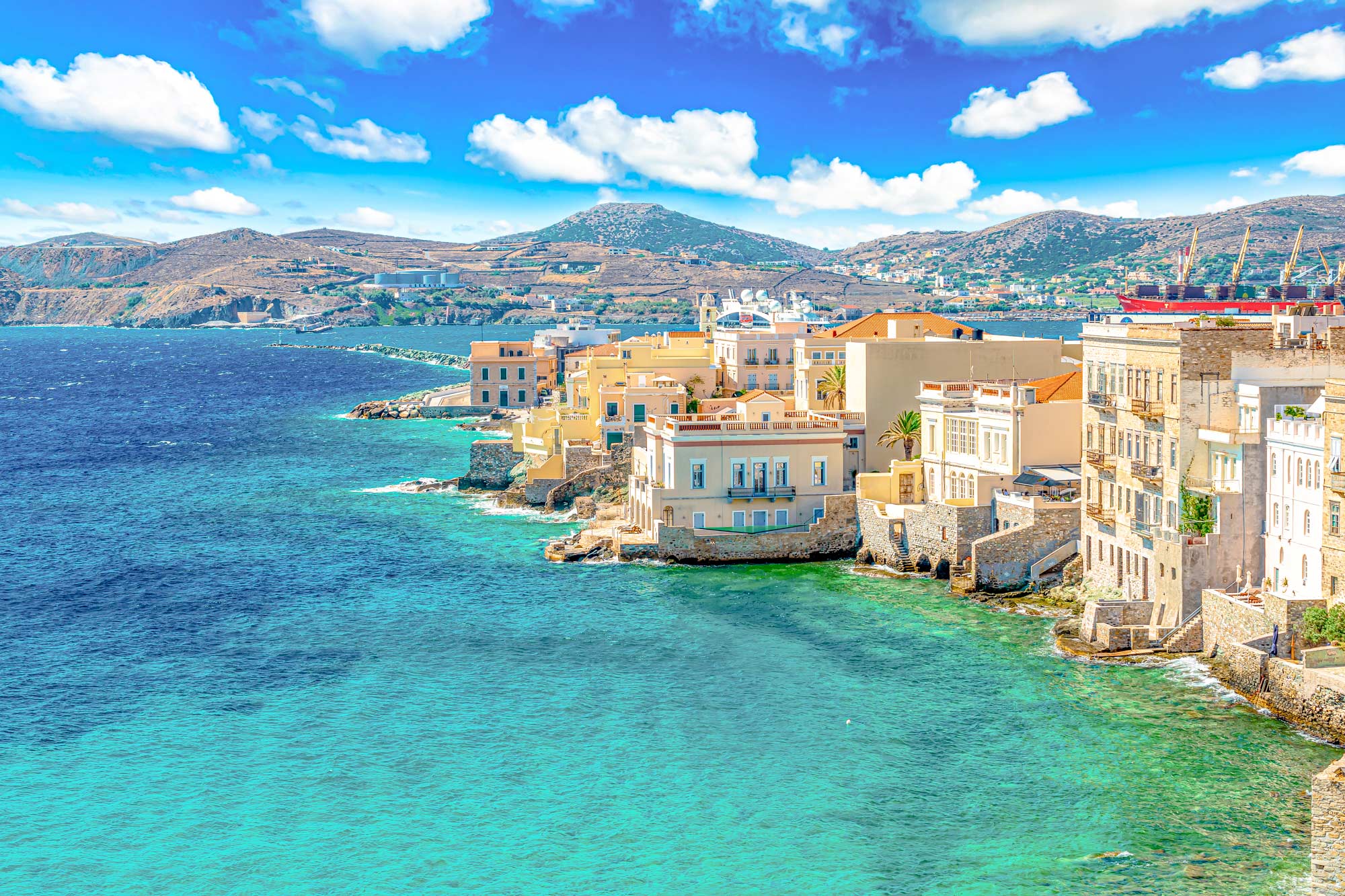
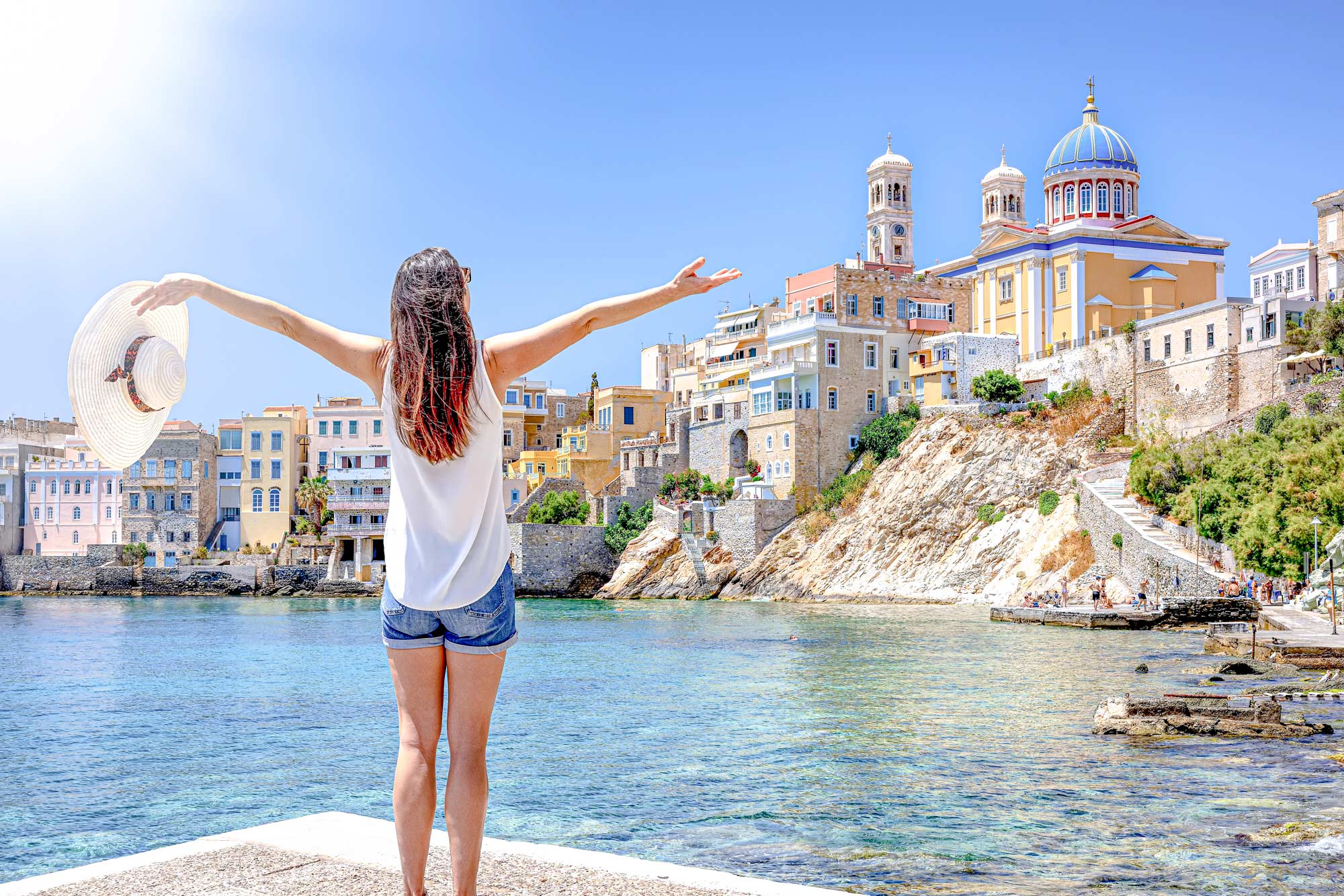
On the seaward side of Ermoupoli, below the church of Agios Nikolaos, lies Vaporia, the old quarter of the sea captains and shipowners. Here the grandest of the neoclassical mansions stand shoulder to shoulder along narrow lanes, their pastel facades, painted ceilings and marble balconies facing straight out over the Aegean. Many are built right to the edge of the low cliffs, so that their back terraces drop directly into the water. 

That is the quarter’s particular pleasure. Below the houses, concrete platforms and ladders have been let into the rocks, and the people of Ermoupoli swim here in the shadow of their own city, stepping off the terraces of the captains’ houses into deep blue water with the town at their backs.  

ANO SYROS AND THE CATHOLIC HILL

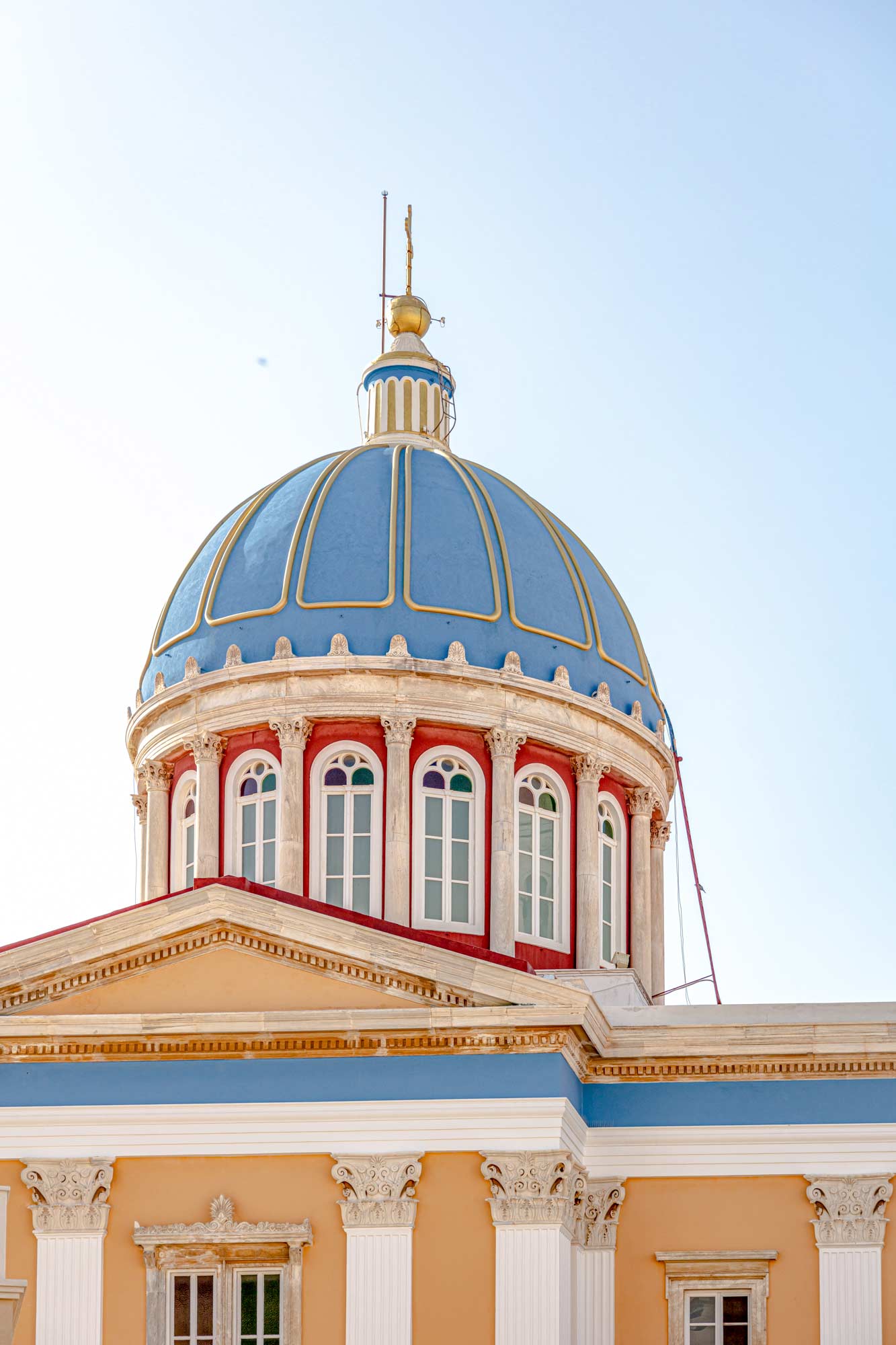
Long before Ermoupoli existed, island life gathered on the hill of San Giorgio, in the medieval settlement of Ano Syros. The Venetians founded it in the early 13th century, and it remains a near-perfect medieval village: a spiral of stepped alleys, whitewashed archways, and tiny squares winding up to the Catholic cathedral of Saint George at its summit, with views across to Tinos, Delos, Mykonos, and Paros. 

Syros carries a religious history unlike anywhere else in Greece. Under Venetian rule, the island became overwhelmingly Roman Catholic, and it kept that faith under later French protection, which helped it stay neutral and prosper while much of the Aegean was at war. To this day, Syros has one of the largest Catholic communities in the country, and Ano Syros keeps its own bishop, its Capuchin and Jesuit monasteries and its Latin feast days, a hilltop world apart from the Orthodox town below. 

A WORKING ISLAND

What sets Syros apart, in the end, is that it’s always been a working island.. As the administrative capital of the South Aegean region, it carries the ministries, courts and hospitals of the whole Cyclades, and its harbour is a busy port. The Neorion shipyard, opened in 1861 and among the oldest heavy industries in Greece, still repairs and refits vessels on the edge of town; its cranes are part of the skyline you see on the way in. 

This is why the island feels different at every hour. The cafes on Miaouli Square are full of civil servants, students, and visitors; the shops sell hardware and school books alongside loukoumi; the season stretches to either side of summer because the town has its own reasons to exist. You are not staying in a holiday stage-set  but in a small city that happens to be beautiful and happens to have very good beaches nearby. 

LOUKOUMI AND THE REBETIKO

Syros eats well. The island is famous across Greece for loukoumi, the rosewater-and-sugar sweet the Chian refugees brought with them in the 19th century, still made by long-established family workshops in Ermoupoli and boxed for the ferry home, along with halvadopita, a soft nougat pie sold from the same counters. From the Catholic villages of the north comes San Michali, a hard, sharp cow’s-milk cheese with protected status that Greeks call their parmesan, grated over pasta or eaten with a glass of the local raki-like souma. 

The other great Syrian export is a sound. Markos Vamvakaris, the patriarch of rebetiko, the smoky urban blues of the 20thcentury, was born in Ano Syros in 1905, and his song Frangosyriani, a love letter to a Catholic girl of the island, is one of the most beloved in the language. A small museum in his old quarter keeps his memory, and on summer nights you can still hear bouzouki drifting out of the tavernas in the upper town.

THE BEACH

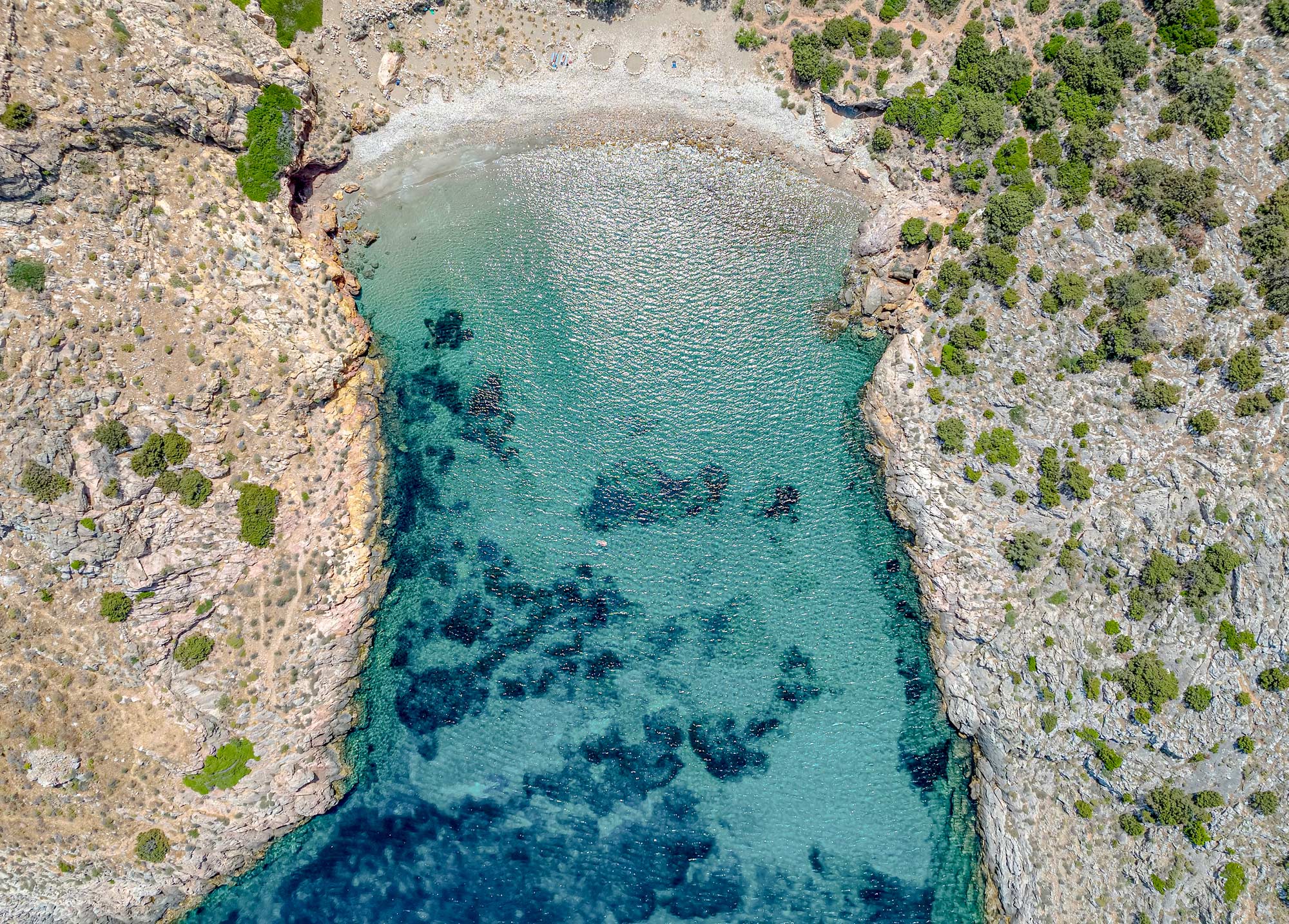
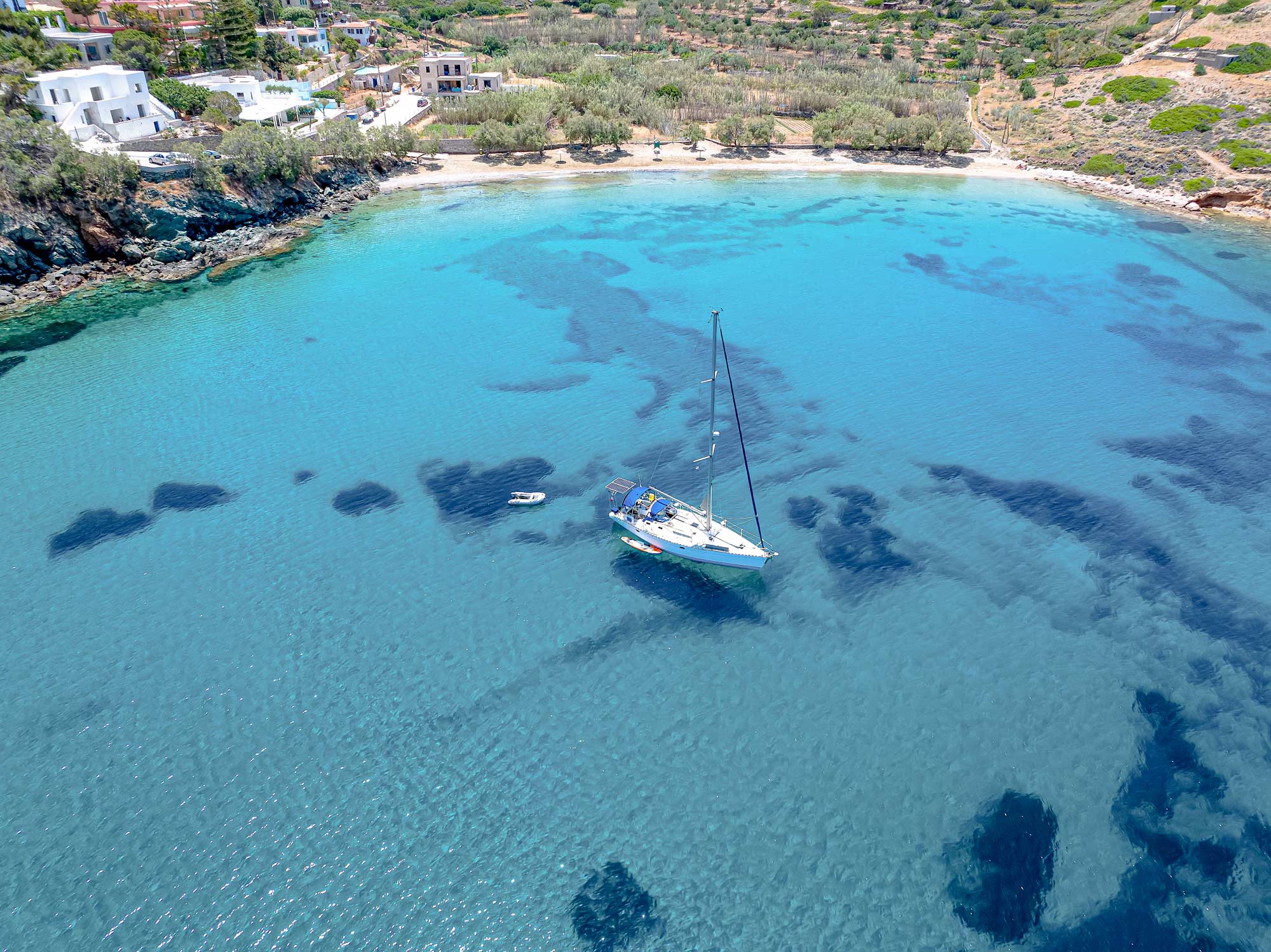
For an island so defined by its town, Syros has a gentle, underrated coast, mostly on the softer western and southern shores. Galissas, on the west coast, is the largest and easiest: a broad sweep of golden sand and warm, shallow, Blue Flag water backed by tamarisk trees, a favourite with families and an easy half-hour from Ermoupoli. Just north, Kini is a pretty fishing village whose west-facing bay draws people at the end of the day for  one of the finest sunsets in the Cyclades. A short walk or drive north of Kini, Delfini is the quieter alternative, a half-sand, half-pebble cove sheltered by its slopes and screened by trees, with far fewer people. The south of the island holds more: Megas Gialos and Vari, and the clear water of Komito and Agathopes near the cape. 

WHEN TO VISIT

Syros is at its best from May to early October, but because it is a real town, it rewards visits at the shoulders of the season more than most islands. June and September are the sweet spot: warm sea, long light, the beaches quiet and every taverna and cafe open. July and August are hot and lively, and the meltemi can blow hard, though the west-coast bays around Kini and Galissas are the sheltered choice on a windy day. Out of season, the island keeps working, so spring and autumn bring the Apollon’s theatre and opera season, and the Catholic and Orthodox calendars fill the year with feast days. Easter, celebrated by both communities, and the summer’s cultural festivals in Ermoupoli are worth planning a trip around if the dates align. 

GETTING HERE

For a small island, Syros is unusually easy to reach, because it is the ferry hub of the Cyclades. Syros National Airport, three kilometres from Ermoupoli, offers short domestic flights from Athens that take around 35 minutes, though services are limited and the aircraft are small turboprops. Most visitors come by sea. Frequent ferries run from the port of Piraeus, taking roughly two and a half hours on a fast boat or about four hours on a conventional ferry, with additional sailings from Lavrio near Athens airport. Once here, you are at the crossroads of the archipelago: as the administrative and transport capital of the Cyclades, Syros has direct connections to almost every island in the group, with the near neighbours of Tinos and Paros a short hop away and the rest of the Cyclades within comfortable reach for an island-hopping week. 

SYROS WITH VILLA COLLECTIVE

Syros is the Cycladic island for travellers who want a place with a pulse of its own, and Syros offers this in spades: a grand, lived-in neoclassical capital with an opera house and a culture that runs all year, and an island that never lost its own reasons to exist. The houses follow suit. Some are restored captains’ mansions in the Vaporia district, with painted ceilings, marble balconies and the sea directly below the terrace; others sit above the quieter bays of the west coast, within reach of Kini’s sunsets and Galissas’s sands. Whichever you choose, the Villa Collective team knows the island from the inside: they can secure a seat for a performance at the Apollon, a table in an Ermoupoli square on a festival night, a visit to a loukoumi maker’s workshop, or a boat around to Kini for the sunset and a plate of fish. To begin, explore our collection of villas on Syros, or browse the wider islands of Greece. 

EXPLORE THE JOURNAL

DISCOVER MORE

A villa for every occasion Finding the perfect villa that suits a large group is the first step in making sure your celebration sings. We can match you with the ideal property for your party, plan all the big and little details ensuring your occasion rises far beyond expectations. Read our recommendations for big gatherings.
5 Reasons to Book Your 2027 Villa Holiday Now 2027 bookings with rates guaranteed at 2026 levels. Five reasons to plan your villa holiday early — from peak-date availability to the finest homes across the Mediterranean and beyond.